
“Vibe coding.”
Three years ago, that phrase didn’t exist. If you walked into a dev meetup in 2023 and said “I’m going to build a full SaaS app this weekend by talking to my laptop,” people would’ve assumed you were either joking or had a very different definition of “SaaS app.”
Fast forward to right now, people are doing exactly that. Non-coders are shipping real products on Lovable before lunch.
Freelancers are building $6K client projects in a weekend and posting the receipts on YouTube. Claude Code users are wiring up entire automation backends through MCP servers while half-watching a podcast.
A guy on Reddit last week showed his full N8N workflow that Claude built for him in ten minutes. It used to take him three hours to wire that manually.
Building stuff is basically FREE now, and THAT is the problem.
Andrej Karpathy, the guy who is a founding member of OpenAI and ran AI at Tesla, coined “vibe coding” in February 2025, but by early 2026, Karpathy himself was already calling it“passé.”
He moved on to “agentic engineering” because the tools got that much better, that fast. The man who named the movement outgrew his own term in less than twelve months.
Think about what that means for you as a builder.
If the terminology can’t even keep up with the speed of AI tooling, your product definitely won’t keep up either.
Not on features, not on capabilities.
Someone will clone what you built. Probably within weeks. Maybe days, and their version might be better because they had access to the next model update that dropped while you were still writing your launch email.
Karpathy calls this era “Software 3.0.” Software 1.0 was writing code, Software 2.0 was training neural networks.
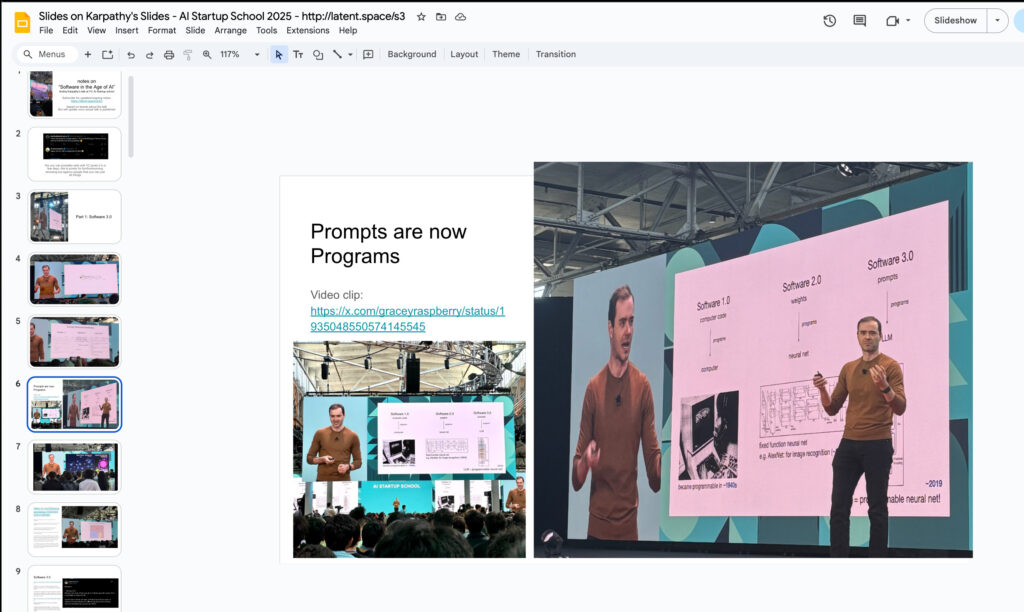
Software 3.0, English is the programming language. LLMs are the runtime, and if everyone is speaking the same language to the same models, building the same types of tools with the same AI, then what actually separates the winners from the 10,000 apps nobody downloads?
Not the product, BUT the distribution.
ChatGPT hit 100 million users in two months. Then Threads did it in five days. The speed of attention is wild, but the speed of irrelevance is wilder.
You can build the best AI tool on the planet, but if nobody knows it exists, it doesn’t matter. You’ll watch someone with a worse product and a better distribution strategy eat your lunch while you’re still tweaking your onboarding flow.
That’s what this article is about. Not how to build. You already know how to build, or you can learn it in a weekend with Cursor or Claude Code or GPT or Lovable or whatever drops next Tuesday.
This is about the part that actually determines whether your thing survives… getting it in front of people.
Repeatedly. At scale, before someone else does it first.
In the AI era, distribution IS the product. And the builders who figured that out early are the ones pulling away from everyone else right now.
Let me show you how they did it.
The Old Playbook Is Dead. The New One Costs GPU.
Traditional SaaS had a beautiful formula. Build something great, then acquire users at near-zero marginal cost. Every new user was basically free to serve. A server running your web app didn’t care if 100 people or 100,000 people clicked the login button.
AI flipped that.
Now, every single user costs real money. GPU cycles. API calls. Token processing. When someone fires up your AI tool and runs a query, that’s not “free traffic,” that’s your AWS bill going up in real time.
A free trial isn’t just “top of funnel” anymore. It’s a line item on your P&L.
And while your costs are going UP per user, your feature moat is going DOWN, because anything you build with AI, someone else can build with the SAME AI. Often faster.
That “novel summarization feature” you spent three weeks on, and it’s one model update away from being a default capability in ChatGPT.
This creates what I call the builder’s dilemma… grow too fast and you’ll bleed money on compute. Grow too slow and a competitor clones your entire product before you hit 1,000 users.
So what’s actually defensible?
Not your features, not your tech stack, not your fine-tuned model (which will be obsolete in six months anyway).
YOUR DISTRIBUTION.
Networks don’t get cloned and relationships don’t get cloned. A community of 10,000 people who trust you and share your stuff with their friends, No LLM on earth can replicate that.
Your product is temporary. Your distribution is permanent.
And the smartest companies in AI right now, they understood this before they wrote their first line of code.
Case Studies: How The Winners Actually Did It
Enough theory. Let’s look at the companies that are WINNING in 2026 and reverse-engineer what they did, because the patterns are clear once you see them.
Lovable: Riding a Cultural Wave to $100M ARR
45 employees, $100M ARR in 8 months. Yeah, read those numbers again.
Lovable, a Swedish AI coding platform, became the fastest software company EVER to hit $100M in annual revenue in 2025, not the fastest AI company. The fastest software company, faster than OpenAI, faster than Cursor, faster than Wiz.
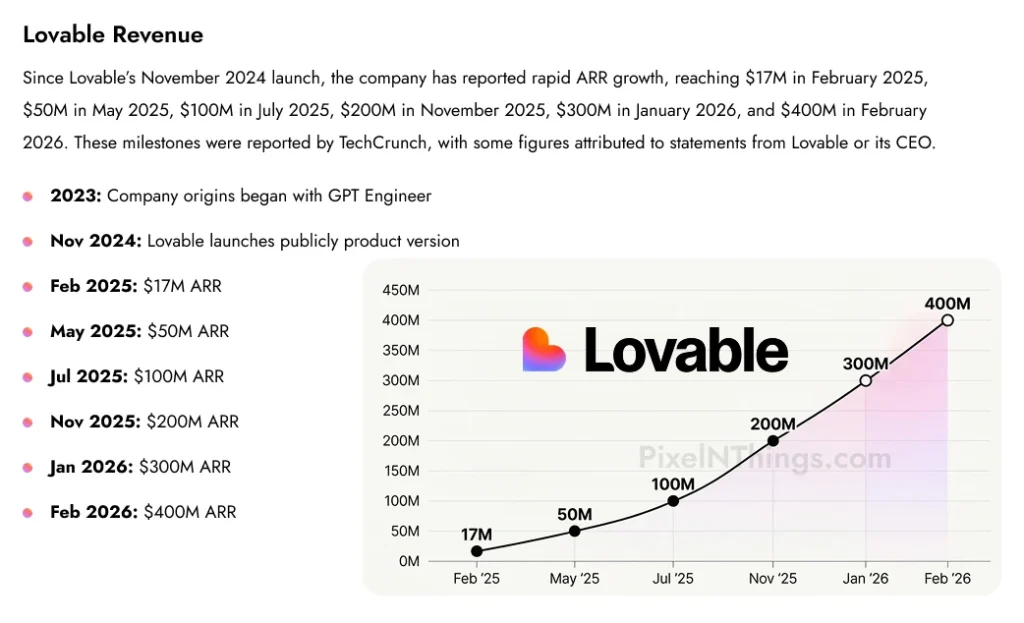
They did it with 45 full-time employees and 2.3 million users, and they did NOT invent their distribution channel.
Fast forward to today… Lovable has scaled to $400M ARR while keeping the team remarkably lean at 146 employees. Despite supporting nearly 8 million users, they’ve maintained a staggering efficiency of $2.7M in revenue per employee.
Andrej Karpathy coined “vibe coding” on X in February 2025. Collins Dictionary made it Word of the Year. The cultural moment was already building. Lovable was just perfectly positioned to ride it. They didn’t create the wave. They were standing on the surfboard when the wave showed up.
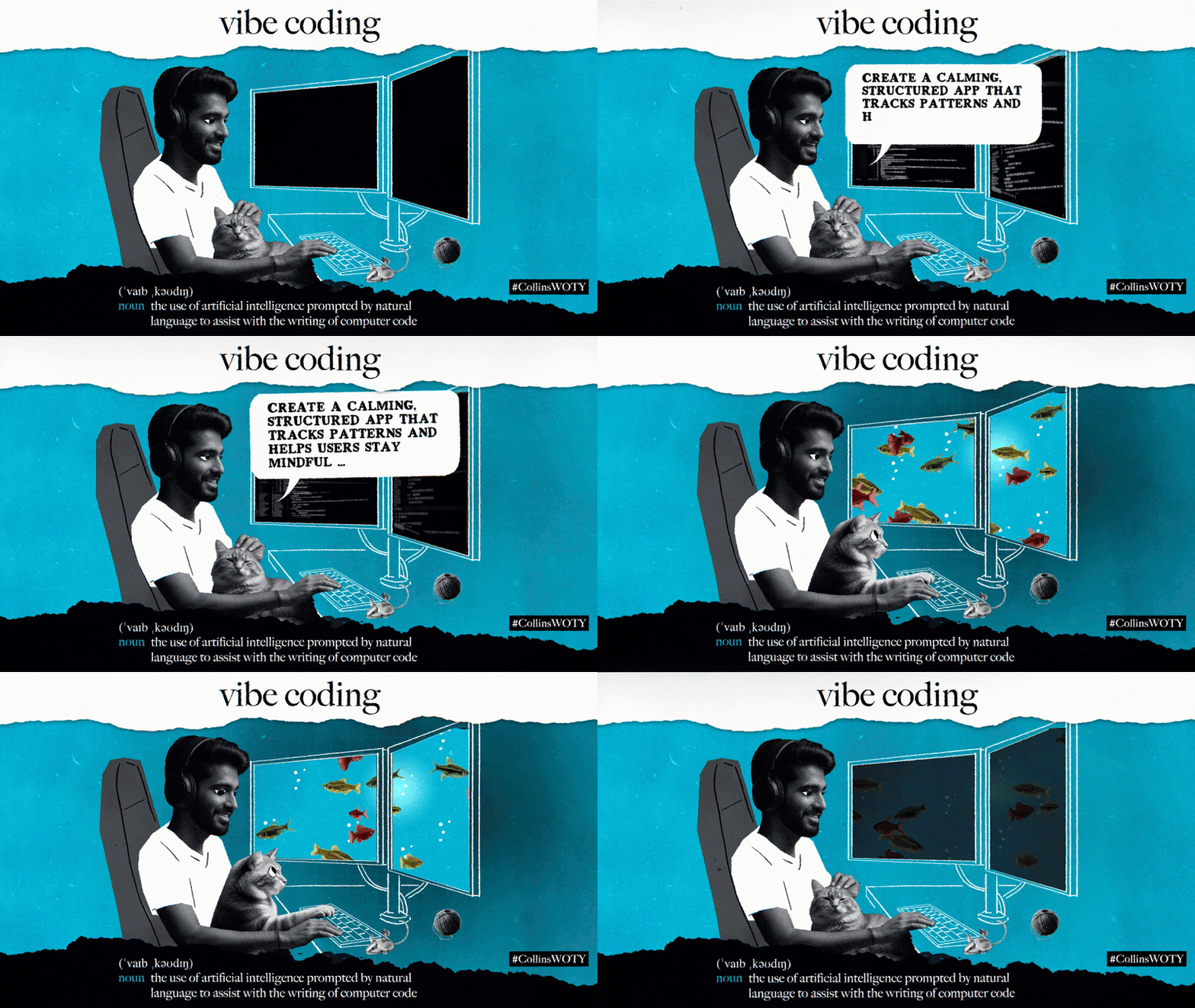
Their actual distribution mechanics were smart as hell…
- YouTube tutorials showing people building real projects and making real income with Lovable.
- Press coverage that wrote itself because the growth numbers were so absurd that journalists couldn’t NOT write about them.
- Every app shipped on Lovable was itself a case study. The outputs distributed the product.
Lesson is, you don’t need to create the cultural moment. You need to see it coming and position yourself so that when it hits, you’re the default tool.
Then make your outputs prove the value so other people do your marketing for you.
Clay: Invent The Job, Own The Category
Clay didn’t just build a product. They named a job that didn’t have a name yet.
Before Clay pushed the term GTM Engineer into circulation in 2023, the actual work was getting done by whoever they could find.
Sales ops people, marketing ops people, growth guys or automation freelancers. The work was real but the role was invisible. Clay gave it a title, a salary expectation, and a career path.
That move compounded fast. By 2025, around 100 GTM Engineer job postings were going live every single month.
A later snapshot counted 400+ roles posted over a 4.5-month window at a median salary of $160K. Those aren’t people buying a SaaS tool. Those are people building a career around it.
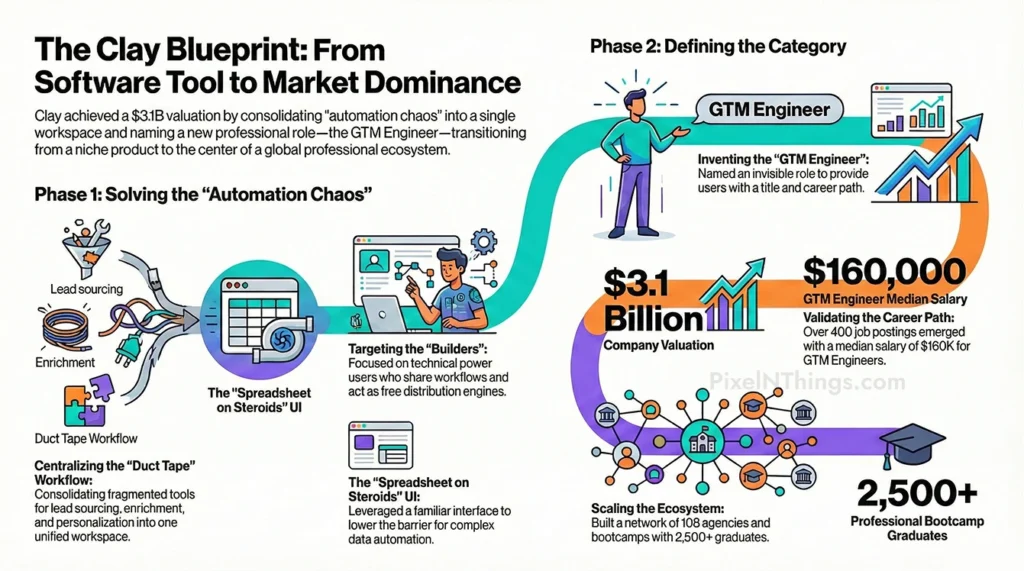
Then Clay turned the category into a whole ecosystem. 108 agencies worldwide, 60 clubs across 30 countries, seven independent bootcamps that had already graduated 2,500+ students.
None of that was Clay selling seats, that was an entire professional community organizing itself around a term Clay put in the air.
The business side reflects it. $100M Series C, $3.1B valuation. On track for $50M in 2025 revenue just from data and integration partners.
The lesson isn’t about Clay the product. It’s about what they did before the product even mattered. When you name the category, you become the default tool in it.
You’re not fighting for share of an existing market. You’re building the market and you’re standing at the front door before anyone else knows there’s a door.
Category creation is distribution. Most companies never figure that out.
Perplexity: Platform Embedding at Hardware Scale
There’s a narrative floating around that Perplexity grew because they had “shareable answers” and “viral social content.”
That’s not wrong, exactly, but it’s like saying Amazon grew because they “sold books.” Technically true. Completely misses the real story.
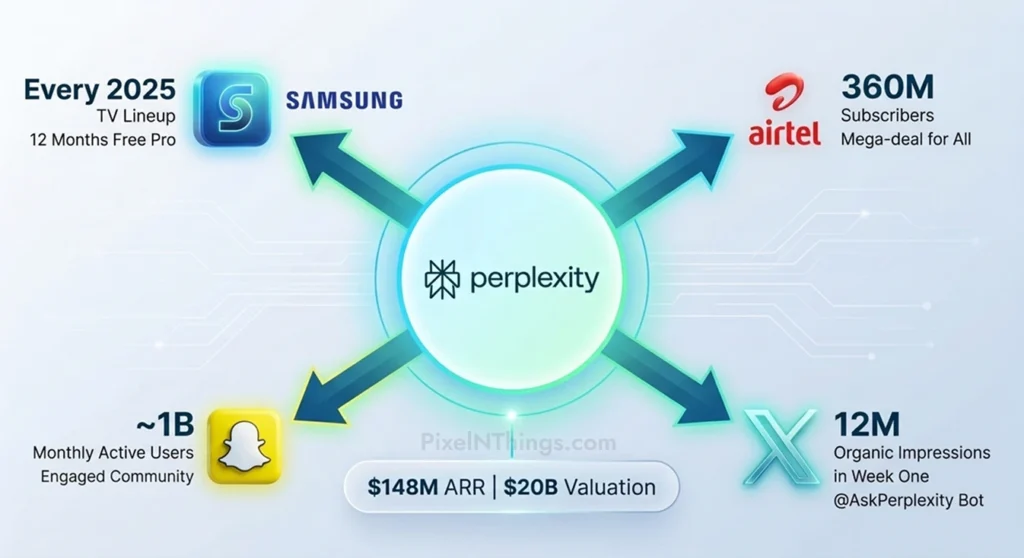
Perplexity’s REAL distribution strategy was embedding themselves into platforms where hundreds of millions of people already were. They didn’t ask users to come to them, they went to where the users lived.
- Samsung TVs. Every 2025 Samsung TV lineup shipped with Perplexity available on the remote. Every buyer got 12 months of Pro free. That’s not a partnership announcement, that’s distribution baked into hardware sitting in living rooms.
- Airtel India. They handed free Perplexity Pro to 360 million telecom subscribers. India was already their fastest-growing market, 640% year-over-year user growth and 2.8 million app downloads in Q2 alone. And this just poured gasoline on a fire that was already burning.
- Snapchat. Starting early 2026, Perplexity is the AI search engine inside Snapchat’s chat interface. Close to a billion monthly active users.
- @AskPerplexity on X. Tag them in any tweet, get an AI answer back. 12 million organic impressions in week one.
Result… 45 million monthly active users, $148M ARR, ~$20 billion valuation.
The lesson isn’t “get on Samsung TVs.” You don’t have that budget and neither do I. The lesson is the principle… stop building a destination and start living inside tools people already open.
Stop asking people to download your app. Embed yourself where they already spend time. That’s distribution that compounds without you touching anything.
Harvey: Win The Flagship, Unlock The Industry
Legal is one of the most hierarchical industries on earth. If you’re selling AI to law firms, you don’t start by cold-emailing 500 mid-size firms. You start by winning the most prestigious firm in the room.
Harvey did exactly that.
In early 2023, Allen & Overy (now A&O Shearman) became the one of the first Magic Circle firms at an enterprise scale, 4,000 staff across 43 jurisdictions.
They then co-built ContractMatrix, an AI contract review tool, with Harvey and Microsoft. 2,000 lawyers now use it daily, saving up to ~7 hours per contract review.
The result, every other firm watched… and then followed, because in law, prestige flows downhill. If A&O Shearman trusts Harvey with their client work, it must be safe enough for us.

One logo. One anchor partnership. And it opened up an entire industry. Harvey has since expanded into broader AI workflows across legal work.
They’re now at an $11 billion valuation with 100,000+ lawyers across 1,300 organizations running work on the platform. But none of that would have mattered without that first flagship win.
The lesson is in the hierarchical industries, one anchor client is worth more than 1,000 sales calls. Co-develop with the best, publicize the hell out of it. Let prestige imitation do the rest.
Claude Code: The MCP Ecosystem as Distribution Infrastructure
This is one of the most interesting distribution stories happening right NOW, in real time, and most people are still sleeping on it.
Claude Code is going mega viral on X, Reddit, and Facebook. Miles Deutscher called it out, developers are posting workflow threads daily, and the community energy is unlike anything since the early ChatGPT days. But the virality isn’t the interesting part.
The interesting part is HOW Anthropic built distribution into the architecture itself.
MCP (Model Context Protocol) is an open standard introduced by Anthropic in late 2024, that lets Claude Code connect to basically everything.
Your database. Your design tool. Your CRM. Your deployment pipeline. Your N8N automations. Your Google Drive. And the ecosystem has exploded.
Over 10,000+ active MCP servers on GitHub in early 2026, a 10x increase from the year before, with adoption across products like ChatGPT, Cursor, Gemini, Microsoft Copilot, and VS Code.
- People are building full SaaS apps, UGC content pipelines, video automation, and complex workflows all through Claude Code and MCP.
- N8N and Claude Code: You describe what you want automated in simple language. Claude builds the entire N8N workflow for you. What used to take three hours of manually wiring nodes now takes about ten minutes. There are 1,396+ automation nodes available through the MCP bridge.
- Google NotebookLM and Claude via MCP: People are connecting their NotebookLM research (unofficial/community-built bridge) libraries directly to Claude, creating research-to-content pipelines that auto-generate presentations, articles, and scripts grounded in actual data.
- 84% of developers now use or plan to use AI coding tools (Stack Overflow 2025 survey).
And the surface area keeps expanding. Claude Code CLI is where the power users live, running agentic workflows straight from the terminal.
But Anthropic also rolled out Cowork (a desktop tool for non-developers), Dispatch (multi-agent orchestration), and a Chrome extension that turns browser context into AI context.
Each one is another distribution surface. Every new interface is another way Claude shows up in someone’s daily workflow.
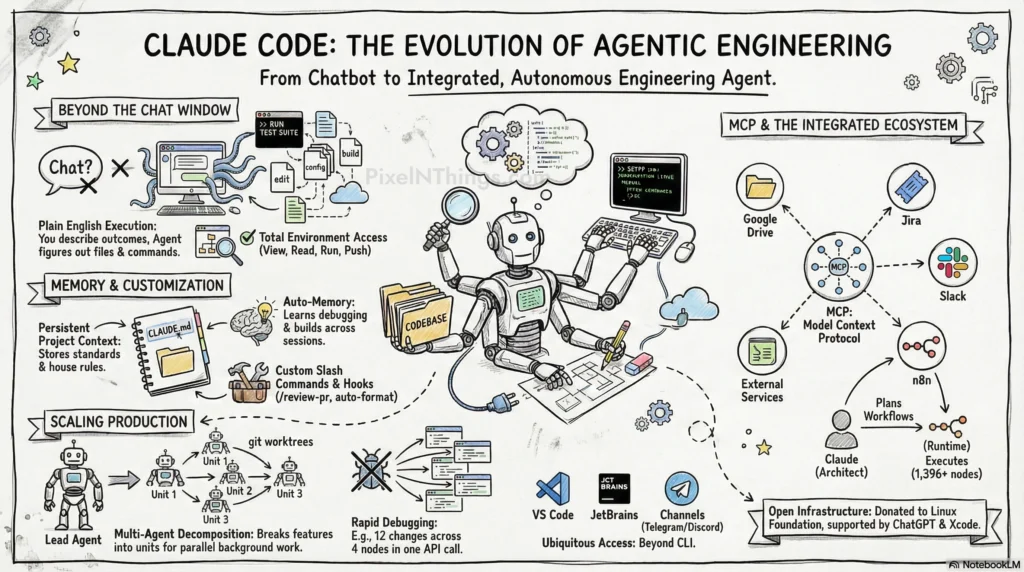
Anthropic didn’t just build a better model. They built MCP as an open protocol that turns every developer, every integration, and every workflow into a distribution node. The ecosystem distributes Claude.
The lesson is build the protocol, not just the product. When your architecture is open and composable, your users become your distribution army.
Every new server, connector, and workflow becomes another reason to adopt the platform.
Three More Hits. Same Pattern. Different Playbook.
ElevenLabs figured out something most SaaS companies never do. A lot of the voiceovers people create with ElevenLabs end up as short-form content on TikTok and Instagram.
Every video that uses their AI narrator voice is a live demo of the product, no ad budget required.
a16z’s Olivia Moore called out the trend in real time… AI narrator voices took over TikTok practically overnight. That’s not a marketing campaign, that’s a product that markets itself every time someone uses it.
Cluely went a completely different direction. Their entire brand was built on one word… cheating. Cheating at work, cheating at interviews, cheating at life.
It got them profiled in The Verge, debated in The Times, and invited to TechCrunch Disrupt 2025 where CEO Roy Lee stood onstage and argued that virality isn’t a happy accident, it’s a deliberate strategy. They raised $15M from a16z off the back of it. Controversy, done right, is just distribution with better optics.
Runway played it quiet. In December 2025, they embedded their Gen-4.5 model into Adobe Firefly, putting it directly inside the creative ecosystem that millions of professional creators already work in every day.
They didn’t rely only on asking creators to adopt a separate tool from scratch. They became part of Adobe’s workflow, with outputs moving naturally into Premiere Pro and After Effects for refinement.
When your distribution strategy is “become part of the tool professionals already can’t live without,” you skip the entire customer acquisition problem.
Three companies. Three completely different bets. The thing they have in common… none of them built a bigger sales team to grow.
The Distribution-First Playbook for AI Builders
OK, so you’ve seen the case studies. You’ve seen what Lovable, Clay, Perplexity, Harvey, Claude, and the rest did. Now the question is: how do YOU apply this?
Whether you’re a vibe coder shipping your first SaaS, a solo builder with a cool AI tool, or a founder raising your seed round, the framework is the same.
Start With The Channel, Not The Feature
Before you write a single line of code, before you open Cursor or Lovable or start prompting Claude. Before any of that… answer one question:
“How does this distribute itself?”
If you don’t have an answer, you’re building a hobby project, and there’s nothing wrong with hobby projects. But if you want people to actually USE the thing, the distribution mechanism needs to be in the spec from day one.
This is where most solo builders get it backwards. They spend three weeks building something cool, ship it, post it on Twitter once, get 4 likes from their friends, and decide “marketing doesn’t work.”
NO. You didn’t work at it.
The move is to reverse-engineer from the channel. Always. If your audience lives on LinkedIn, build something that creates LinkedIn-native outputs.
If they’re on TikTok, build something that generates short-form video content. If they’re developers, build something that plugs into their existing workflow (VS Code, terminal, GitHub).
That’s what “start with the channel” actually means when you don’t have a marketing budget.
Make Your Outputs Do The Marketing
This is the single most powerful distribution lever you have when you’re building alone with no ad budget. The concept is simple… when someone uses your tool and creates something, that creation should sell your tool for you.
The big companies already figured this out. Every voiceover made with ElevenLabs is a live demo of ElevenLabs. Every app someone ships on Lovable is a walking case study.
Every landing page built on Systeme.io with that little “Made with Systeme.io” footer is a free ad running 24/7 that Systeme didn’t pay a cent for.
But you don’t need to be ElevenLabs to use this. You just need to think about what your user PRODUCES when they use your thing… and make that output do double duty.
Say you build a proposal generator for freelancers. Every proposal sent to a client is a potential touchpoint. A subtle “Generated with [YourTool]” at the bottom.
A clean design that makes the client ask “what did you use to make this?” That’s distribution you didn’t grind for. It just happens every time someone uses what you built.
But there’s a key distinction… watermarks are punishment. Signatures are prestige.
Nobody brags about removing a watermark. But people leave “Shot on iPhone” in their captions, people keep “Built with Webflow” in their portfolio footers. They leave it because it signals taste, not because they forgot to delete it. That’s what you’re aiming for.
Think about how to embed your brand identity into outputs.
My whole point is every user becomes a distribution node. Not because you asked them to promote you. Because the thing they made with your tool naturally puts your tool in front of the next person.
You build once. Every output runs a tiny, silent campaign for you.
Plug Into Where People Already Are
Building your own audience from zero is the slowest path to traction. The faster move is to go where the audience already exists and embed yourself there.
This is the Perplexity model. The Runway model. Instead of building your own audience from scratch, plug into platforms that ALREADY have the audience.
But for a sec, forget the Perplexity/Samsung partnership stuff. That’s for companies with BD teams and corporate dev budgets.
For solo builders, “embed into existing ecosystems” means something much simpler… go list your thing everywhere people are already looking for solutions.
- Chrome Web Store
- VS Code extensions
- GitHub Marketplace
- Shopify App Store
- WordPress plugin directory
- Figma Community
- GHL marketplace
- Systeme.io template library
These are distribution channels with built-in search traffic and built-in trust. Someone browsing the Chrome Web Store is already in buying mode.
They’re looking for a tool to solve a problem RIGHT NOW. You don’t have to convince them they have the problem, you just have to show up.
This is where solo builders have an actual advantage over bigger companies. You can ship a Figma plugin in a weekend.
You can build a Chrome extension in a day with Cursor or Claude Code. You can list a GHL snapshot or a Systeme.io template in an afternoon.
Big teams take six weeks to get approval for the same move.
The other play is building on top of platforms people already use daily. A Slack bot that does one thing well, a Notion integration, or Google Sheets add-on. You’re not asking anyone to change their workflow. You’re just showing up inside it.
Every listing is a distribution node that works while you sleep, and they compound. The more places your tool shows up, the more “normal” it feels. The more normal it feels, the less friction there is to adoption.
Someone sees your tool in the Chrome Web Store, then notices it in a Facebook group recommendation, then sees it mentioned in a Reddit thread. By the third touchpoint they’re not gonna evaluate you, they’re just gonna install your damn app.
The play for bootstrapped builders is volume of surface area, not depth of any single channel.
List everywhere, be findable in every marketplace your audience browses. Let the platforms do the distribution work their algorithms were built for.
Build Community Flywheels
The Clay story is a masterclass in this, but you don’t need a $3.1B valuation to run the same play at a smaller scale.
The principle is simple… give people something they can use, win with, and share. Templates, prompt libraries, starter kits, cheat sheets. Anything repeatable that delivers a quick result.
When someone downloads your free GHL snapshot, sets it up in 20 minutes, and books their first appointment that week… they’re going to tell someone.
Not because you asked them to, because they’re excited and want to look smart. That’s a flywheel. Your freebie creates a win, the win creates a story, the story creates distribution.
Where most solo builders stop is the freebie. They give away the template and move on, but the compounding happens when you build a space where those people can gather.
A Discord server, a free Facebook group, a community on Skool, again doesn’t matter what platform. What matters is that users start teaching other users.
That’s when it flips from you pushing content to the community generating it for you. Someone posts a walkthrough of how they customized your template, someone else asks a question and three people answer before you even see it.
You went from solo builder to ecosystem, and you didn’t hire anyone.
If you want to accelerate it, add status, leaderboards. “Top Creator” spotlights. A simple badge system. People are wired to chase recognition.
Every time someone posts “Just hit my first $1K month using [YourTool]” with your brand attached, that’s a testimonial, a case study, and a free ad rolled into one.
The flywheel only works if the initial artifact actually delivers a result. Nobody shares something that didn’t work for them. So make the first win easy, make it fast, and make it shareable.
The community builds itself from there.
Use Humans Where AI Can’t
Trust. Empathy. Relationships. Nuanced negotiation. Creative judgment.
AI generates volume, humans build trust. That distinction matters more than ever right now in this AI age.
AI can write 50 LinkedIn posts, but a human decides which 3 are actually worth posting. AI can research 10,000 leads, but a human builds the relationship that closes the deal.
AI can generate a hundred variations of ad copy, but a human knows which one sounds like something a real person would actually say.
The solo builders winning at distribution right now are not going “all AI.” They’re using AI to handle the repetitive volume work so they can spend more time on the stuff only a human can do.
Showing their face on video, responding to comments with actual thought, jumping on a 15-minute call with a potential customer instead of sending them through a seven-email nurture sequence.
This is especially true as the AI content flood keeps rising. Platforms are getting overrun with faceless, generated content and audiences are rejecting it faster than ever.
YouTube is banning AI faceless channels, comment sections are turning on creators the moment something smells automated. The bar for human trust is going UP, which means your actual face, your actual voice, your actual opinion becomes a distribution advantage that no model can replicate.
If your entire brand presence feels generated, people check out.
Keep yourself visible, record the Loom, do the live stream, reply to the DM yourself.
That’s not “unscalable.” That’s the moat.
Pricing and Funnels That Don’t Bleed Money
Quick look on the AI pricing because this is where solo builders quietly go broke.
Generous unlimited free tiers can wreck a bootstrapped AI product fast. I mean, seriously… every free user costs you compute. If your tool goes viral before your pricing is dialed in, your growth can outrun your margins.
Lovable is a good example of the opposite approach… even with nearing 8 million users and over $400 million in ARR in 2026, its free plan remains tightly capped at 5 daily credits with a 30-credit monthly limit.
For most bootstrapped AI products, the “grow first, monetize later” playbook is much harder to survive without outside capital. You don’t have a Series A backstop, you have a credit card and an API bill that hits at the end of the month.
What tends to work when you’re funding this yourself…
Usage-based pricing. Charge per generation, per output, per API call. One of the cleanest ways to keep costs aligned with revenue in compute-heavy products. If a user generates 10x the output, they pay 10x more. Your costs scale with your revenue instead of ahead of it.
Hybrid is probably your best starting point though. Base subscription that covers your overhead plus usage credits for anything above the included tier. They blow through credits, they buy more.
This gives you recurring revenue you can plan around while keeping heavy users from eating your margins. For most solo builders, this is probably the strongest starting point.
And do yourself a favor… include compute in your CAC. If it costs $10 in ads and $1 in GPU to acquire a free trial user, your acquisition cost isn’t $10. It’s $11.
I know that sounds obvious but almost nobody does the math this way. Then they’re staring at a spreadsheet three months in wondering why the numbers don’t work.
The funnel itself works better as a loop than a straight line. Awareness through content and social, interest through a free trial or demo and activation when they hit their first win, retention through community and ongoing value, revenue when they upgrade and referral when they share what they built.
That last stage is where everything from Section 2 kicks back in. If the outputs your users create are good enough to share, every paying customer can feed the top of your funnel without you lifting a finger.
The person who used your tool to generate a proposal sends it to a client. The client asks what tool made it. New user enters the loop and you didn’t spend a dollar on that acquisition.
When you’re one person with no ad budget, that kind of compounding loop is one of the best ways to grow without burning out or burning through cash.
Content Strategy for Distribution-First Builders
Content is not a “nice-to-have” marketing add-on. For distribution-first builders, content IS the distribution engine. Full stop. If you’re not making content, you’re invisible, and invisible products don’t make money.
The good news is, you don’t need to be a content machine. You need to be a content recycler.
The framework is…
One piece of content, multiple formats. You write one solid blog post, that becomes a LinkedIn carousel, that becomes a Twitter thread, that becomes an email to your list, that becomes a 60-second TikTok, that becomes a YouTube Short.
Same core insight, tailored to each platform’s culture.
AI makes this stupid fast. MCP tools and Claude workflows can compress what used to be 20 hours of weekly content production into 2-3 hours. The bottleneck isn’t creation anymore. It’s curation and quality control.
And that decision… that’s where you come in.
What to actually post about:
- 40% tactical tips (the “how to” stuff that drives search traffic)
- 30% case studies (real numbers, real companies, real results)
- 20% opinion and thought leadership (your takes, your predictions, your hot-but-defensible opinions)
- 10% community spotlights (featuring users, sharing wins, making other people look good)
The distribution mechanism inside the content itself. Every piece you publish should contain at least one of these… a shareable stat, a quotable line, a strong opinion, something people can argue with, a downloadable template, or a “tag someone who needs to see this”.
If your content can’t be screenshotted, quoted, or debated… it won’t spread.
That’s what separates your content from the ocean of AI-generated filler flooding every platform right now. And the human-in-the-loop is NON-NEGOTIABLE.
AI drafts, humans review, edit, and approve. Not because AI can’t write, because AI writes average, and average doesn’t build a brand.
Your voice, your opinions, your weird specific takes that only you would have, THAT is what makes people follow YOU and not just consume random AI content.
The Risks You Have To Be Aware Of
I’m not going to sugarcoat this for you. If you’re building with AI and ignoring the regulatory side, you’re setting yourself up for problems you didn’t budget for.
Data privacy rules are tightening everywhere. GDPR and CCPA were just the start.
The Colorado AI Act is currently set to take effect June 30, 2026, and it requires impact assessments, transparency statements, and consumer protections for “high-risk” AI systems.
The EU AI Act is rolling out in parallel. If you’re building with AI and collecting user data, you need to know this stuff. Ignorance isn’t a defense.
The point is that this stuff is moving way too fast, it varies by jurisdiction, and “I didn’t know” isn’t going to help you if something goes wrong.
If your tool touches user data or makes decisions that affect people’s lives, finances, or opportunities, keep an eye on this, Or find someone who will.
IP ownership is still a gray zone. Who owns AI-generated content? Legally, it’s not settled. If your tool generates something that looks a lot like someone’s copyrighted work, you could be in trouble.
Audit your training data sources. Include clear terms of service about output ownership. Cover your bases now before a lawsuit forces you to.
Bias and misinformation scale with distribution. This is the ugly flip side of everything we’ve been talking about.
Every viral share of a biased AI output damages your brand, and the better your distribution gets, the MORE damage a bad output does. Human review is not optional anymore, it’s risk management.
Brand trust is fragile. If your audience starts to suspect that EVERYTHING on your site, your social, your emails is AI-generated slop with no human behind it, they’ll bounce. They won’t tell you why. They’ll just stop engaging. Keep real humans visible. Real names, real faces, real opinions.
That’s the trust layer that no automation can replace.
Distribution IS The Product
Let me bring this home.
The AI era rewards builders who think about reach before they think about features. Your code can be cloned in a weekend.
Somebody with Cursor and a free afternoon can rebuild most of what you ship. But your network can’t be cloned, your community can’t be cloned, the trust you’ve built by showing up with your face and your name and your actual opinions for six months straight… nobody can copy-paste that.
The pattern across everything we’ve covered in this piece is the same.
The winners didn’t just build something good. They built something that spread itself. Through cultural moments (Lovable), through category creation (Clay), through platform embedding (Perplexity), through prestige partnerships (Harvey), through open protocols (Claude/MCP), through provocation (Cluely), through outputs that doubled as marketing (ElevenLabs).
Before your next build, try this… write the distribution plan first. Before the feature spec, before the wireframe, before you open Cursor or Lovable or start prompting Claude.
Ask: Who is this for? Where do they already spend time? How does this reach them without me manually pushing it? And how does every user who touches this thing make it easier for the NEXT user to find it?
Answer those questions. Then build the thing that fits.
That’s the playbook. Now go use it.
See you in the next one. PEACE ✌️
About

Nick Chauhan
Web Developer & Founder Of PixelNThings
I build AI-powered systems that actually ship. Agents, automations, full-stack apps. Claude, Cursor, Gemini, MCP, n8n, Stitch etc.. Also design high-converting funnels and website on Systeme.io, WordPress & GoHighLevel. I post what I build.

